
1. There is still huge room for growth in the global installed capacity of photovoltaic power generation.
In 2024, the total new installed capacity of photovoltaics in China reached 277GW, a year-on-year increase of 27.8%, and the highest new installed capacity in history. From January to July 2025, the newly installed photovoltaic capacity in China reached 223.3GW, a year-on-year increase of 87.7%, maintaining a rapid growth trend.
In terms of installed power generation structure, since 2015, the proportion of new energy generation capacity represented by solar and wind power has gradually increased, while the proportion of installed power generation capacity of thermal power and hydropower has shown a downward trend. The national installed power generation capacity has increased from 1.51 billion kilowatts in 2015 to 3.35 billion kilowatts in 2024, with an average annual compound growth rate of 9.3%. As of July 2025, the installed power generation capacity in China is approximately 3.67 billion kilowatts, an increase of 18.2% compared to the same period last year. Among them, the total installed capacity of solar and wind power accounted for 45.9% of the total installed capacity, an increase of 7.0 percentage points compared to the same period last year. The installed capacity of thermal power and hydropower decreased to 40.5% and 12.0% respectively.
Since 2020, the completion amount of power engineering investment in China has significantly increased, exceeding the completion amount of power grid engineering investment in the country. From January to July 2025, the cumulative investment in power engineering in China reached 428.8 billion yuan, a year-on-year increase of 3.4%; The cumulative investment completed in national power grid projects reached 331.5 billion yuan, a year-on-year increase of 12.5%, showing a relatively fast growth trend. The investment in national power grid projects maintains a rapid growth trend, which is conducive to promoting the construction of ultra-high voltage projects and upgrading of distribution networks, and promoting the intelligent transformation of domestic power grids. It helps to solve the bottleneck problem of power generation and consumption brought about by the rapid development of new energy in China.
The penetration rate of photovoltaic power generation in China has been increasing year by year from 0.4% in 2014 to 9.7% in 2024, surpassing the world average. In contrast, the penetration rate of photovoltaic power generation in multiple European economies exceeds 10%, and the power grid remains stable. Among them, the penetration rate of photovoltaic power generation in Germany and Italy is about 12%, while the penetration rate of photovoltaic power generation in the Netherlands and Spain exceeds 16%. As China accelerates the construction of new energy supporting power grid projects, the domestic ultra-high voltage transmission network continues to improve, and the carrying capacity of distributed new energy continues to increase, China still has the potential to carry more photovoltaic power generation in the future.
The penetration rate of photovoltaic power generation between China and the world
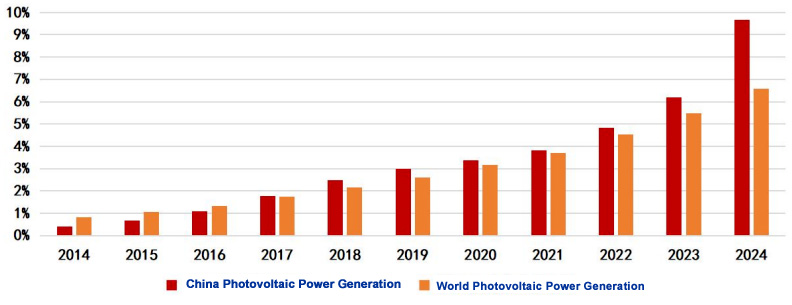
Source: CPIA, Dongguan Securities Research Institute
According to CPIA, the global new installed capacity is expected to reach approximately 530GW in 2024, a year-on-year increase of 35.9%. In an optimistic scenario, it is expected that the global new installed capacity of photovoltaics will reach 1078GW by 2030, an increase of 103.4% compared to 2024. The annual compound growth rate of global new installed capacity of photovoltaics from 2024 to 2030 is about 15.3%, and there is still significant room for growth in global photovoltaic installed capacity in the future.
In recent years, with the growth of photovoltaic demand and the improvement of cost-effectiveness of tracking brackets, the global shipment volume of tracking brackets has shown rapid growth. According to the prospectus of Youli Intelligent, global tracking bracket shipments have grown rapidly from 2017 to 2023, reaching 92GW by 2023 and a CAGR of 36% from 2017 to 2023, showing a high-speed development trend. In 2022-2030 photovoltaic installations (including large utility scale, small utility scale, and large commercial power stations), the tracking rack penetration rate in the United States, Spain, Latin America, the Middle East, Australia and other countries or regions is at a high level of about 90%, India, South Africa, France and other countries is about 40-50%, and the tracking rack penetration rate in Chinese Mainland is about 10-20%.
At present, tracking brackets are applied to large ground power stations, and the global demand for tracking brackets depends on the penetration rate of tracking brackets and the newly installed capacity of large ground power stations. According to the prospectus of Youli Intelligent, in 2024, the global photovoltaic bracket market size is about 183.6 billion yuan, of which the global tracking bracket market size is about 79.7 billion yuan, and the global tracking bracket penetration rate is about 52%. By 2027, the global photovoltaic bracket market is expected to reach 223.5 billion yuan, with an average annual compound growth rate of about 6.8% from 2024 to 2027. Assuming that the global tracking stent penetration rate increases to 64% by 2027, the global tracking stent market size is expected to reach 116.3 billion yuan by 2027. From 2024 to 2027, it is expected that the annual compound growth rate of the global tracking stent market size will be about 13.4%, and the annual compound growth rate of the global fixed stent market size will be about 1.0%.
Global photovoltaic bracket market size and tracking bracket penetration rate
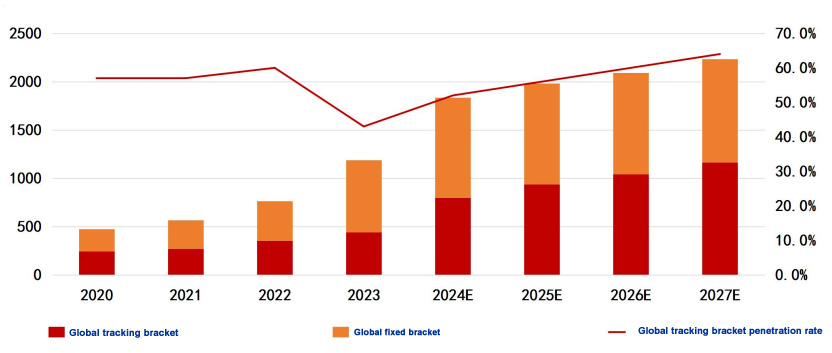
Data source: Youli Intelligent prospectus, CPIA, Dongguan Securities Research Institute and Sihan Calculation
2. The international competitiveness of leading domestic photovoltaic tracking bracket enterprises continues to strengthen
As the "skeleton" of a power station, the technical level and performance of photovoltaic brackets directly affect the power generation efficiency and investment returns of the photovoltaic power station. At the same time, photovoltaic brackets are non standardized products that require high design and development capabilities and experience from enterprises. The photovoltaic bracket industry is a technology intensive industry with high technical barriers.
In the overall scheme design phase, it is necessary to design a suitable technical route, product scheme, power station layout, material selection, and other overall schemes based on complex factors such as radiation, latitude and longitude, climate, topography, soil conditions, and land costs in the area where the power station is located. At the same time, the overall plan should fully consider technical, economic and other indicators, balancing the relationship between cost and cost and power generation gain.
In the mechanical structure design process, photovoltaic power plants are generally located outdoors facing various harsh environments such as sandstorms, rain and snow, air corrosion, high and low temperatures, and frozen soil layers. Photovoltaic brackets need to meet high-performance standards such as strength, weight, wear resistance, corrosion resistance, and anti tipping. Therefore, it is necessary to scientifically design mechanical structures, select material types reasonably, conduct sufficient testing and inspection, and effectively control product costs.
In terms of production technology, the main components of photovoltaic brackets adopt multiple processing techniques such as cold bending, stamping, sawing, laser cutting, plasma cutting, welding, hot-dip galvanizing, etc., which have high requirements for product processing accuracy, production efficiency, and quality consistency; In terms of tracking and control technology, it is necessary to continuously optimize tracking and control algorithms, develop new tracking and control technologies, and improve the automation and intelligence level of photovoltaic power plants.
Therefore, the photovoltaic bracket industry has high technical barriers in overall scheme design, mechanical structure design, production process, tracking control and other aspects. At the same time, as the photovoltaic industry fully enters the era of high-power modules, module sizes are increasing and module weights are correspondingly increasing. The increase in module area will bring about a larger windward area, resulting in increased static and dynamic loads on the bracket, especially for tracking bracket systems that require greater structural locking force.
Along with the development of component technology, the stability and reliability of brackets are also facing new challenges. In the design of tracking bracket structures, some tracking bracket suppliers have used wind resistant structural design and wind tunnel testing technology to continuously improve the working wind resistance of tracking brackets and achieve greater power generation.
Although the photovoltaic bracket industry in China is still dominated by fixed brackets, most companies have begun to focus on tracking brackets and have business layouts overseas. From the overall pattern of the global market for tracking brackets, the market concentration is high, mainly dominated by foreign manufacturers. Among them, Nextracer, as the global leader in tracking brackets, has consistently ranked first in shipment volume for many years. As a global provider of photovoltaic brackets and BIPV system solutions, Zhongxinbo has a relatively advantageous competitive position in the industry. Zhongxinbo has strong advantages in research and development, technology, and products, and its market position has steadily increased in recent years.
3. Major domestic and international photovoltaic bracket manufacturers
NEXTracker is headquartered in California, USA. Founded in 2012, it is a company mainly engaged in photovoltaic tracking systems. In 2015, it was acquired by the Fortune 500 company FLEX. The shipment volume and market share of the company's photovoltaic bracket products and tracking bracket sub products have long been ranked first in the world, with the main sales market being North America.
Array Technologies, headquartered in New Mexico, USA, was founded in 1985 and is a company primarily engaged in photovoltaic tracking systems. The company has over 30 years of experience in the photovoltaic tracking system industry. And acquired another photovoltaic tracker giant in January 2022, STI Norland。 The company's main sales markets are the United States, Latin America, and South America.
PV Hardware, headquartered in Madrid, Spain, was founded in 2009 and is a company primarily engaged in photovoltaic tracking systems, energy storage, and SCADA solutions. It operates over 100 projects worldwide. PVHardware is a subsidiary of EPC company Gransolar. The company's main sales markets are the Middle East, Africa, and Europe, and it is a leader in the Middle East market.
Soltec is headquartered in Murcia, Spain and was founded in 2004. It is a company mainly engaged in photovoltaic tracking systems, with its main products being single axis distributed photovoltaic trackers and installation services. We have over 1500 employees and over 250 patents worldwide, with our main sales market located in Latin America.
Game Change Solar, headquartered in Los Angeles, USA, was founded in 2012 and is a company primarily engaged in photovoltaic tracking systems. The company's main sales markets are located in the United States, Latin America, and India.
Nclave is headquartered in Madrid, Spain, founded in 1999. It is a company mainly engaged in the research and development, production, and sales of photovoltaic fixed and tracking brackets, and has successfully completed more than 300 projects. Acquired by Trina Solar in May 2018.
Yihua Co., Ltd. is headquartered in Wenzhou, Zhejiang Province. Founded in 1995, it is an enterprise dedicated to the research and development, production, and sales of connectors and their components, with a focus on communication. We provide customers with comprehensive solutions for interconnect product applications. The wholly-owned subsidiary of the company, Yueqing Yihua New Energy Technology Co., Ltd., mainly engages in the manufacturing and sales of core components for photovoltaic tracking brackets.
Zhenjiang Co., Ltd. is headquartered in Jiangyin City, Jiangsu Province. Founded in 2004, it is an enterprise engaged in the design, processing, and sales of wind power equipment and photovoltaic equipment components. Its main products include wind power equipment products such as engine room covers and rotor rooms, as well as fixed/adjustable photovoltaic brackets, tracking photovoltaic brackets, and other photovoltaic equipment products.
Founded in 2009, Zhongxinbo Company is a leading global manufacturer and service provider of photovoltaic bracket system solutions, providing one-stop solutions and core products for "green electricity+smart energy". The company has participated in a series of domestic and international application projects such as the Photovoltaic Power Generation Leader Program, Affordable Grid, Photovoltaic Poverty Alleviation, and Regional Largest Scale, relying on the excellent performance and good quality of its products.
Antaike Shenzhen Antaike Clean Energy Co., Ltd., established in 2004, provides customers with complete sets of new energy engineering equipment, power plant protection, and environmental protection solutions. Its main products include heat exchanger systems for nuclear power plants, sound insulation/absorption barrier systems for highways, photo thermal system solutions, and photovoltaic tracking systems.
Qingyuan Corporation is headquartered in Xiamen, Fujian Province, established in 2007. It is engaged in the research and development, design, production, and sales of intelligent photovoltaic trackers and other photovoltaic brackets; Development, construction, and operation of photovoltaic power plants; A high-tech enterprise engaged in the research and development, production, and sales of photovoltaic power electronic products. The company has two major production bases in Xiamen and Tianjin
The main business structure of Trina Solar includes four major segments: photovoltaic products, energy storage business, system solutions, and digital energy services. Tianhe Tracking, a sub brand of Tianhe Solar, is a provider of intelligent tracking solutions under the company, with 20 years of experience in tracking brackets.
According to Wood Mackenzie, global tracking bracket shipments in 2024 increased by 20% compared to 2023 to 111GW, with global shipments exceeding 100 gigawatts for the first time. Zhongxinbo and Trina Solar remain among the top ten global suppliers, with Zhongxinbo's global ranking rising from sixth in 2023 to second in 2024, and Trina Solar maintaining its sixth global ranking. In 2024, Trina Solar's tracking bracket shipment reached 7.3GW, ranking among the top five in key markets such as Europe, Latin America, and the Middle East.
In the research and development of tracking brackets, Trina Solar has not only further deepened its investment in structural stability and electronic control intelligence, but also explored solutions for new scenarios such as sandstorms, slopes, and extreme wind and snow weather, including the provision of new pile foundation solutions, extreme climate strengthening components, and intelligent brackets, achieving deep integration of scenario requirements and product applications.
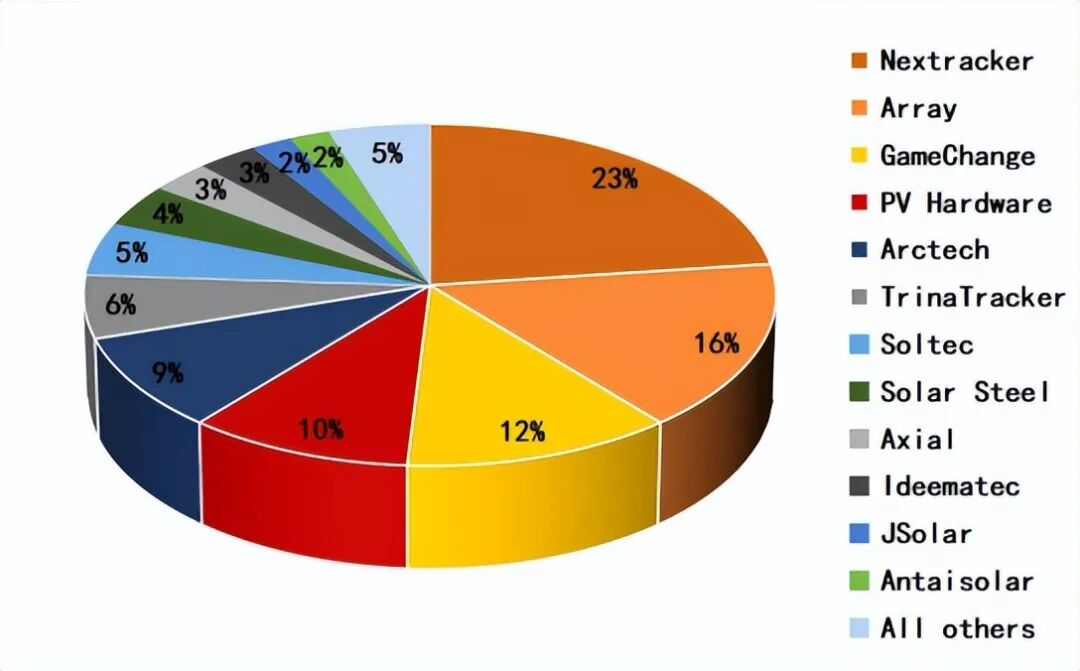
Source: Youli Intelligent prospectus, Wood Mackenzie, Sihan
Tianhe Tracking SuperTrack intelligent algorithm integrates patented technology of double-sided irradiation and micro occlusion model, optimizing power generation efficiency for complex terrain and high scattering irradiation weather conditions. STA dynamically adjusts tracking strategies, SBA inverse tracking algorithm combines terrain data and power generation data to identify occlusions, optimize tracking angles, and has achieved fine-grained adjustment of seasonal and terrain factors. Tianhe Solar won the Silver Award at the 25th China Patent Awards for its patent "A Method for Estimating Direct Radiation Ratio with Dual Radiation Meter" for developing meteorological prediction technology, becoming the first enterprise in the photovoltaic bracket industry to receive this national intellectual property award, marking a key breakthrough in China's photovoltaic bracket technology.
